Starter
For freelancers and small teams.
$ 24 /mo
Billed monthly · cancel anytime
Platforms3
Accounts10
.svg) JSON / CSV / XML query · Power BI format
JSON / CSV / XML query · Power BI format
 JSON / CSV / XML
One source
JSON / CSV / XML
One source
 Saved query
API URL
Power BI
Web · Import
Saved query
API URL
Power BI
Web · Import









Available metrics
Available dimensions
JSON / CSV / XML
3 advertising accounts
Connected
 Google Ads
2 advertising accounts
Connected
Google Ads
2 advertising accounts
Connected
 Google Analytics 4
1 web property
Connected
Google Analytics 4
1 web property
Connected
 HubSpot
1 CRM portal
Connected
HubSpot
1 CRM portal
Connected

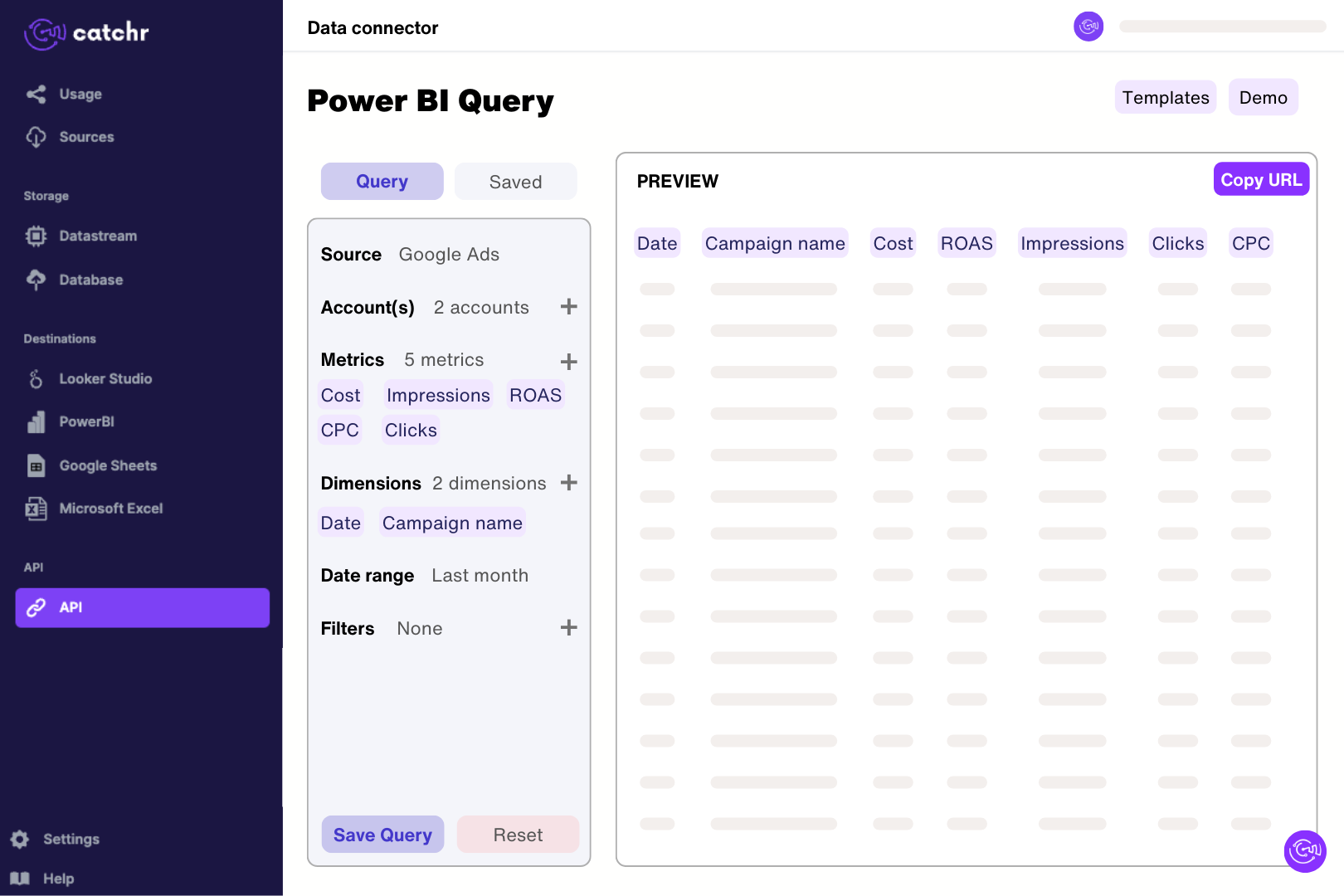
Configure the feed URL, response format, required request headers and record path in Catchr. In Catchr’s Power BI query builder, select a sample of the records returned by the configured URL and preview a short extraction. Import the generated URL through Get data > Web in Power BI Desktop. Check the returned rows before building measures, keeping stable record keys and the completeness of the upstream response clear in the model.
Yes. Use Get data > Text/CSV in Power BI Desktop for a local file. Catchr JSON/CSV/XML reads a remote URL and is useful when the system hosting a feed updates that response over time. A local file and a hosted feed have different refresh requirements: updating a file on your computer does not update a remote endpoint or a published semantic model automatically.
Catchr supports GET and POST requests for this connector. Configure request headers for the authentication your endpoint expects, and provide a request body and content type when the API requires POST. Check that the response contains the report data itself. An endpoint that needs an interactive sign-in or a separate token-renewal workflow may require an intermediate export service.
Use the record path setting to select the part of the parsed response that contains the rows. For example, a response may wrap its records inside a data object rather than return a list directly. Catchr uses a JMESPath expression for this selection, then turns each selected record into a row. Select records at the same level of detail, such as one order per row, before adding charts.
Catchr infers fields from a sample of records and flattens scalar values inside nested objects. Arrays inside a record are not automatically expanded into additional columns or rows. Prepare a flat record list when you need to report on line items, and keep names and data types consistent. A field that only appears outside the sample may not be discovered during setup.
Yes. Catchr can replace date placeholders in the source URL, request headers and POST body with the requested start and end dates. For example, #sdate_hyphen# and #edate_hyphen# use the YYYY-MM-DD format. Use them in parameters your API supports. This passes dates to the endpoint; it does not make a static file filter itself or recover history the endpoint no longer provides.
Check the response supplied by the configured URL, method, headers and body, then verify that the record path selects the required list. An endpoint returning one page of results needs an export or request that supplies the full dataset. Check upstream feed updates and the semantic model's last successful refresh separately. A Power BI refresh cannot add rows missing from the source response.
Our team is always here to answer any questions you may have about our data connector.
Connect your marketing platforms and build a data workflow your entire agency can use.





.svg)



























.png)




.svg)