Starter
For freelancers and small teams.
$ 24 /mo
Billed monthly · cancel anytime
Platforms3
Accounts10
.svg) Amazon DSP query · Power BI format
Amazon DSP query · Power BI format
 Amazon DSP
One source
Amazon DSP
One source
 Saved query
API URL
Power BI
Web · Import
Saved query
API URL
Power BI
Web · Import
Used by the world's leading companies









Available metrics
Available dimensions
Amazon DSP
3 advertising accounts
Connected
 Google Ads
2 advertising accounts
Connected
Google Ads
2 advertising accounts
Connected
 Google Analytics 4
1 web property
Connected
Google Analytics 4
1 web property
Connected
 HubSpot
1 CRM portal
Connected
HubSpot
1 CRM portal
Connected

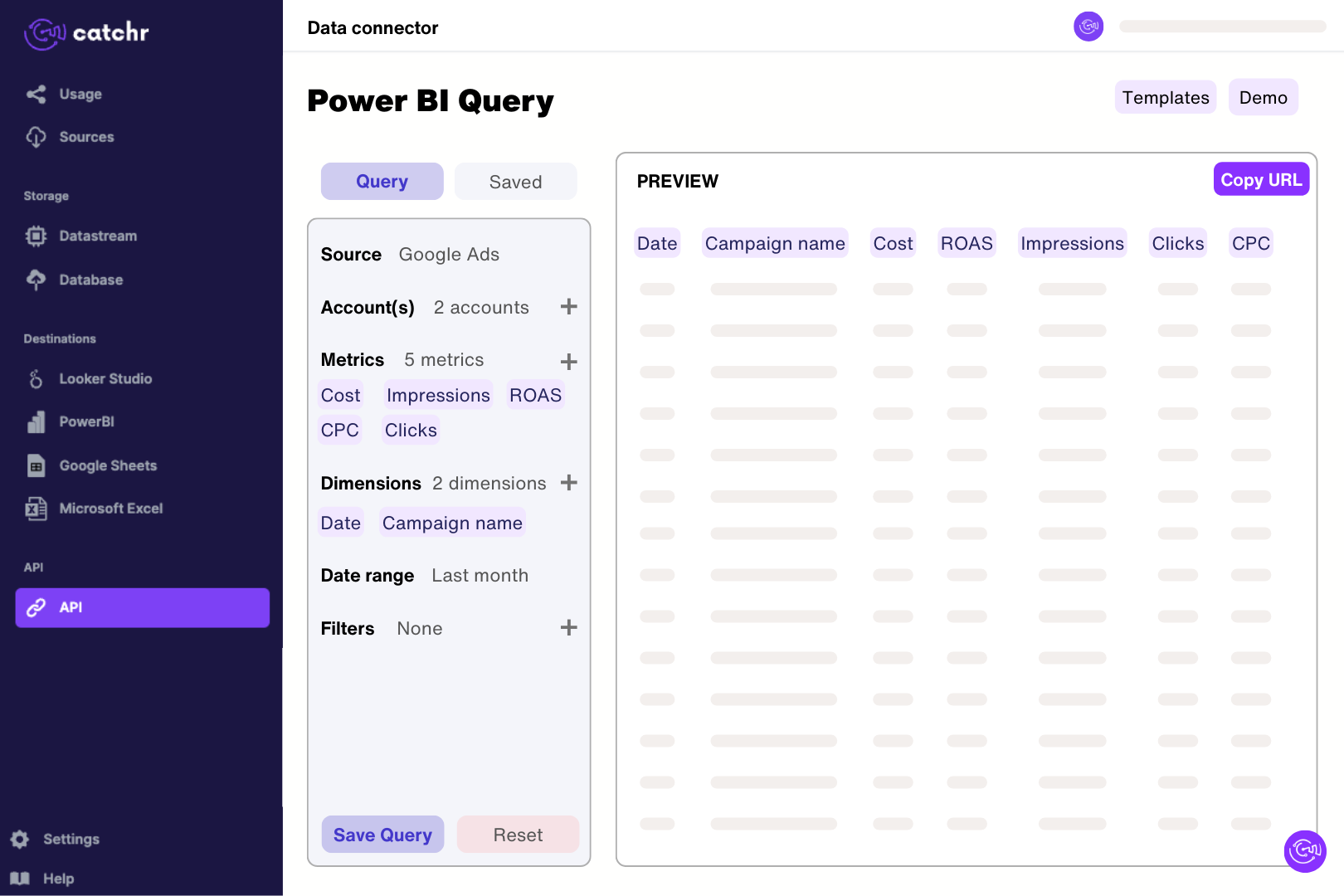
Authorize the Amazon account in Catchr and select your DSP advertiser and report type. In Catchr’s Power BI query builder, select campaign delivery for a completed reporting period and preview a short extraction. Import the generated URL through Get data > Web in Power BI Desktop. Check the returned rows before building measures, keeping report type, advertiser currency and attribution scope clear in the model.
They are separate sources in Catchr. Amazon DSP covers demand-side platform campaigns, while the Amazon Ads connector handles its supported sponsored advertising reports. You can show both in Power BI, but keep report types and attribution definitions visible. This DSP source concerns advertising, not Amazon's Delivery Service Partner business.
Catchr offers campaign, inventory, product, geographic, technology, audience, reach and frequency, audio and video, and bid adjustment report types. Depending on the report, available fields include impressions, clicks, cost, purchases, sales, ROAS, reach and creative details. Select a report first: a field supported by the campaign report is not automatically supported by every other report.
Supply Cost measures media supply, while Total Cost has a broader campaign cost scope. Neither should be silently substituted for the other in a cost-per-result or return calculation. Check the metric definition and which fees your DSP export includes, then use the same denominator throughout the dashboard. Keep agency charges or other separately paid fees explicit if you add them to a business-level cost measure.
No. The same person can be reached on several days, so adding daily unique reach overcounts a period's audience. Use a summary reach report for the period and scope you want to assess. Frequency is also a ratio, not an additive total; do not sum daily frequency values. Keep campaign, advertiser and household audience measures distinct when comparing charts.
DSP reports have different restrictions. Catchr limits most report requests to a 31-day range, while some report types support longer requests. That request limit is separate from how much history Amazon retains. Reduce the date range and select fields from one compatible report level. Audio and video and bid adjustment reports are requested as summaries, so adding a date field does not turn them into daily time series.
DSP sales are advertising-attributed results; Seller Central and Vendor Central describe retail activity with different scopes. Match the sales field, advertiser, dates and currency before comparing. DSP reports are generated asynchronously, so a dashboard query must wait for Amazon's report. Recent results can evolve as attribution is processed; a completed-period comparison is more useful than expecting a live sales counter.
Our team is always here to answer any questions you may have about our data connector.
Connect your marketing platforms and build a data workflow your entire agency can use.





.svg)



























.png)




.svg)