Starter
For freelancers and small teams.
$ 24 /mo
Billed monthly · cancel anytime
Platforms3
Accounts10
.svg) Airtable query · Power BI format
Airtable query · Power BI format
 Airtable
One source
Airtable
One source
 Saved query
API URL
Power BI
Web · Import
Saved query
API URL
Power BI
Web · Import
Used by the world's leading companies









Available metrics
Available dimensions
Airtable
3 advertising accounts
Connected
 Google Ads
2 advertising accounts
Connected
Google Ads
2 advertising accounts
Connected
 Google Analytics 4
1 web property
Connected
Google Analytics 4
1 web property
Connected
 HubSpot
1 CRM portal
Connected
HubSpot
1 CRM portal
Connected

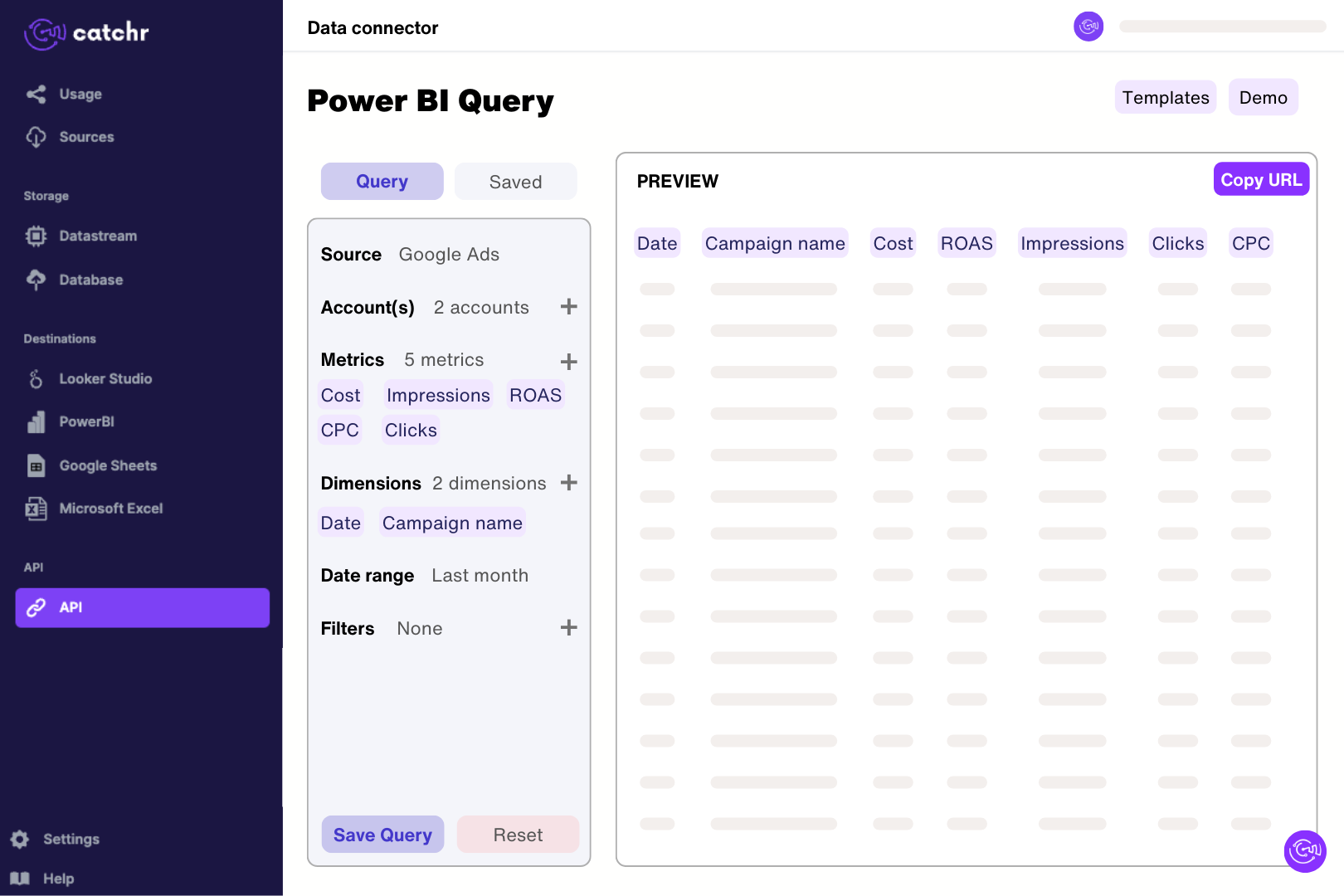
Authorize access to the Airtable base in Catchr and select the relevant table. In Catchr’s Power BI query builder, select record ID and a few stable business columns and preview a short extraction. Import the generated URL through Get data > Web in Power BI Desktop. Check the returned rows before building measures, keeping record IDs and the cardinality of linked records clear in the model.
Yes. Catchr reads the selected table's field definitions and builds fields for the data source. The available columns therefore depend on your base rather than one universal marketing schema. Keep names and types consistent when several tables are intended to support the same dashboard.
Check that the authorization includes the intended base and the necessary read access. Airtable personal access tokens have both scopes and resource permissions, and the token user's own permissions still apply. Access to one base does not automatically grant access to every base in the workspace.
Refresh the source fields in Catchr and review the fields selected in the saved query. In Power Query, check expansion, renamed-column and changed-type steps for references to the old schema. Update the query in Desktop and republish the semantic model when required. Scheduled data refresh cannot repair a transformation step that refers to a removed field.
Yes, but linked records need deliberate handling. They represent relationships rather than a flat measure you can sum. Use record IDs to connect the relevant datasets and decide how multiple matches should be treated. A one-to-many relationship can repeat an amount and inflate totals if it is joined without checking the relationship.
Choose the business date that matches the question, such as campaign launch date, invoice date or task completion date. Record creation time only tells you when the row was created. Catchr exposes creation time separately; it should not silently replace the date on which the underlying activity occurred.
Yes. Add Google Ads and use consistent campaign identifiers to compare budget or planning rows with actual spend. Aggregate both sides to the same campaign and period before creating relationships so a daily spend series does not repeatedly multiply a monthly budget.
Our team is always here to answer any questions you may have about our data connector.
Connect your marketing platforms and build a data workflow your entire agency can use.





.svg)



























.png)




.svg)