Starter
For freelancers and small teams.
$ 24 /mo
Billed monthly · cancel anytime
Platforms3
Accounts10
 Google Play Review query · Power BI format
 Google Play Review
One source
 Saved query
API URL
Power BI
Web · Import
Used by the world's leading companies









Available metrics
Available dimensions
Google Play Review
3 advertising accounts
Connected
 Google Ads
2 advertising accounts
Connected
 Google Analytics 4
1 web property
Connected
 HubSpot
1 CRM portal
Connected

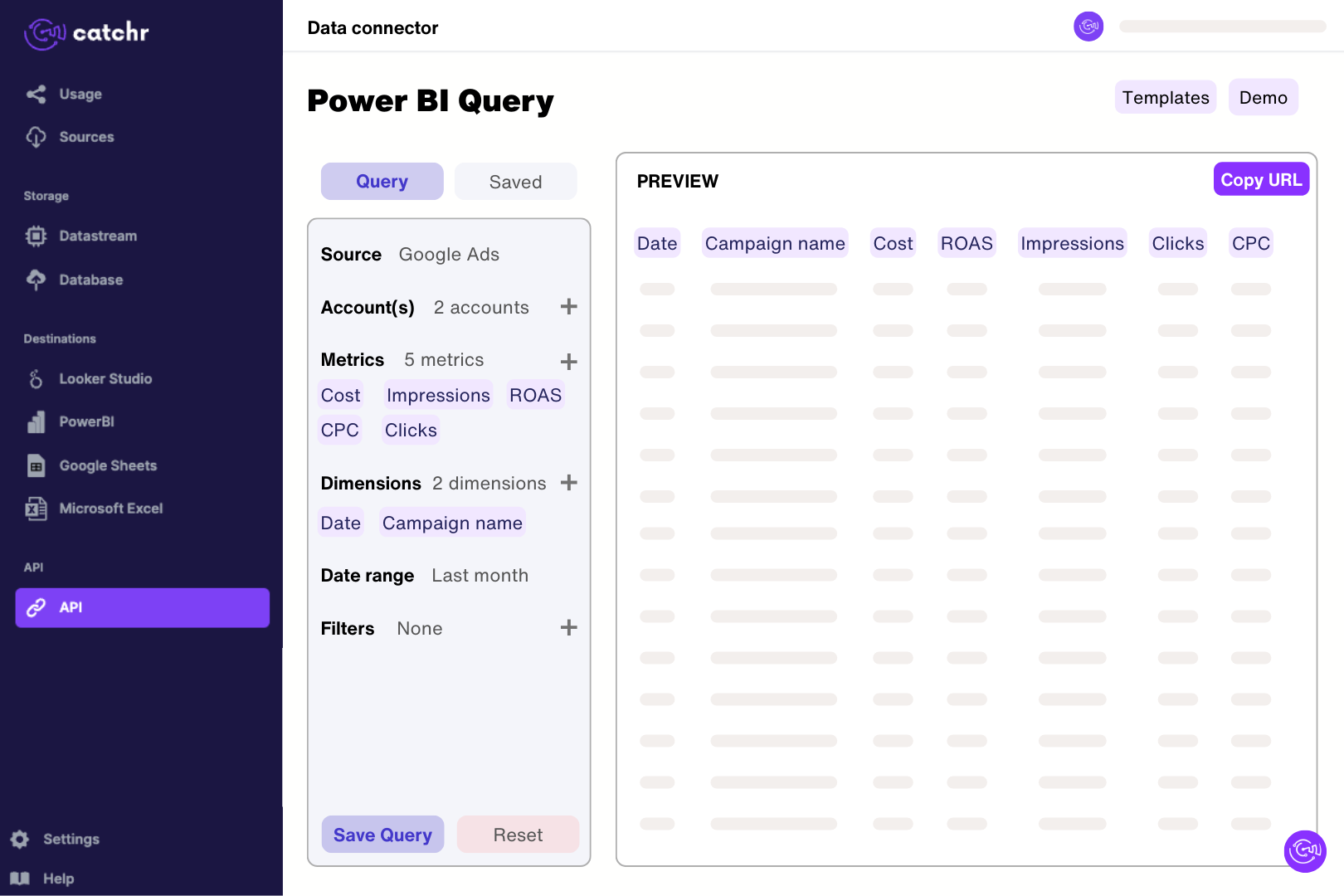
Add the review source in Catchr using the app package identifier from the id parameter in its Google Play URL. Select the configured profile, app or property. Choose the review language. Build a Power BI query with Review Date, Rating and Review Text, preview the returned reviews and import the generated URL using Get data > Web in Power BI Desktop. Set review dates and rating types in Power Query, and retain the source identifier when combining several profiles.
Yes. Catchr provides a language setting for Google Play Review, with English as the default. Keep the chosen language consistent when comparing periods, and label separate language views clearly. This setting is not a country or device filter, and the current review catalog does not expose those breakdowns. Do not interpret an English-language review set as a complete worldwide sample of your app's feedback.
The Google Play Review source focuses on feedback: review text, dates, ratings, reviewer names, review URLs, and helpful votes, plus separate current rating summaries. Its catalog does not include installs, revenue, crashes, device models, or app-version dimensions. For app performance reporting, use the separate Google Play Store source and check its available metrics. Reviews can explain a performance change, but they do not measure how many users experienced it.
Your dashboard average may use only the written reviews returned for a selected language and date range. Ratings can also be submitted without written reviews, and Google weights its displayed rating toward more recent feedback. Compare the same population before treating a difference as an error. Average valid Rating values rather than summing them, and label the result as the average for the retrieved reviews. Google's ratings and reviews guide explains the distinction.
Group individual records by Review Date and count distinct Review IDs. Filter Rating to one star to track that subset, and inspect Review Text to understand the complaints. Helpful Votes can help prioritize feedback, but they are current counts rather than votes received during the selected period. Keep the app-level Review Count, Average Rating, and star-count summaries in separate charts: Catchr cannot request these global fields together with individual review fields.
One request is not an unlimited archive. Catchr follows the provider's pagination tokens until results end, the requested date boundary is reached, or roughly 1,000 matching reviews have been collected. Use smaller date windows for high-volume apps and check the actual oldest and newest records returned. Google also provides developer review exports in Play Console for authorized app teams. Private testing feedback and a complete history of review edits are not exposed by this Catchr source.
Yes. Add the App Store reviews source and map the Android package and Apple app ID to the same product. Keep the platform and chosen language or storefront visible. Compare review volume, rating distribution, and recurring issues using equivalent date ranges. Do not join individual reviews by reviewer name, or assume that a review-date spike identifies the app version responsible: this source does not expose a version field.
Our team is always here to answer any questions you may have about our data connector.
Connect your marketing platforms and build a data workflow your entire agency can use.