Starter
For freelancers and small teams.
$ 24 /mo
Billed monthly · cancel anytime
Platforms3
Accounts10
.svg) Facebook Review query · Power BI format
Facebook Review query · Power BI format
 Facebook Review
One source
Facebook Review
One source
 Saved query
API URL
Power BI
Web · Import
Saved query
API URL
Power BI
Web · Import
Used by the world's leading companies









Available metrics
Available dimensions
Facebook Review
3 advertising accounts
Connected
 Google Ads
2 advertising accounts
Connected
Google Ads
2 advertising accounts
Connected
 Google Analytics 4
1 web property
Connected
Google Analytics 4
1 web property
Connected
 HubSpot
1 CRM portal
Connected
HubSpot
1 CRM portal
Connected

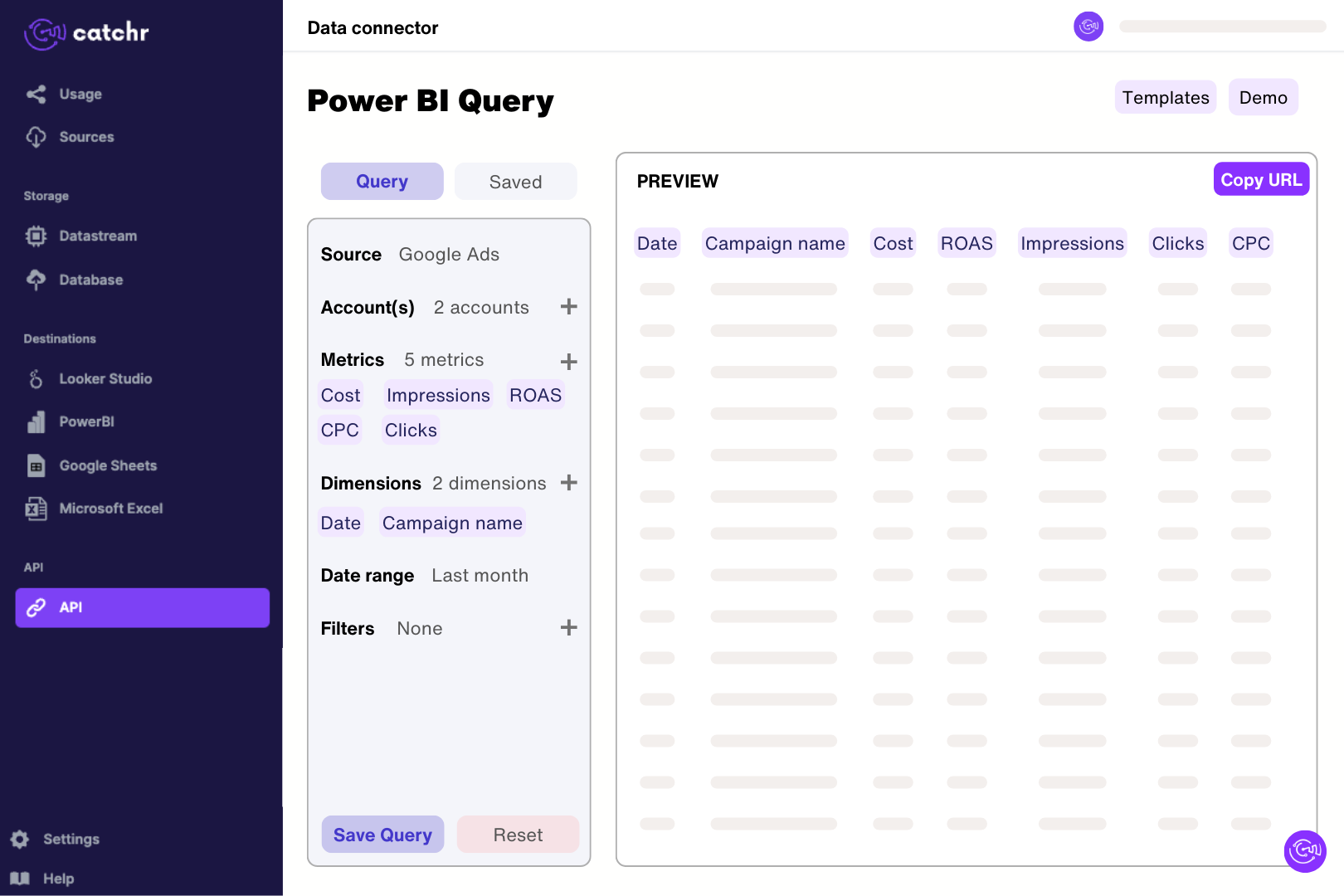
Add the review source in Catchr using the business Page identifier from its Facebook URL. Select the configured profile, app or property. Build a Power BI query with Review Date, Review Text and Recommendation Status, preview the returned reviews and import the generated URL using Get data > Web in Power BI Desktop. Set review dates and rating types in Power Query, and retain the source identifier when combining several profiles.
Facebook uses Recommendations for feedback on business Pages, while older star-rated reviews may also appear. Catchr exposes Recommendation Status and a separate Rating field when a star rating is available. Analyze the status values actually returned; do not treat a missing star rating as zero or assign an invented star score to a recommendation. Keep legacy rating averages separate from the share of reviews recommending the business.
Check the Page's Reviews section and whether Recommendations are enabled. Facebook states that turning Recommendations off removes the Page's visible rating and reviews. Visibility also depends on whether feedback is shared publicly and remains available on Facebook. Then check the Page identifier, review-date range, and refresh state in your report. A connector cannot recover private or removed feedback. Meta's Recommendations settings guide explains where to check.
No. This source focuses on feedback for the configured business Page. It includes review text, dates, reviewer information, recommendation status, review links, and comment counts when available. For organic audience and content reporting, use Facebook Pages; for campaign spend and conversions, use Facebook Ads. Marketplace seller ratings are a separate Facebook feature and are not exposed by this Page-review source.
Group individual records by Review Date and count distinct Review IDs. Break that count down by Recommendation Status to see how the returned feedback changes over time. Use only records with a known status when calculating a recommendation percentage. The Page-level Review Count and Average Rating are current summaries, not monthly snapshots, and Catchr cannot request those global fields together with individual review fields. Keep them in separate scorecards.
Catchr exposes Comments Count and a link to the review, but its current catalog does not include comment text, the identity of the responder, or reply timestamps. A review with comments is therefore not proof that the business has answered it. Use the count to identify active discussions and open the original review to inspect or respond to the conversation. Comments Count is a current value, not the number of comments posted during your selected date range.
One request is not an unlimited archive. Catchr follows the available review cursors until results end, the date boundary is reached, or roughly 1,000 matching reviews have been collected. Use narrower review-date windows for Pages with substantial feedback and inspect the coverage returned. The current Page review total can exceed the individual records in a dashboard. Keep each Page identifier attached to its review rows when comparing several businesses.
Our team is always here to answer any questions you may have about our data connector.
Connect your marketing platforms and build a data workflow your entire agency can use.





.svg)




























.png)




.svg)