Starter
For freelancers and small teams.
$ 24 /mo
Billed monthly · cancel anytime
Platforms3
Accounts10
.svg) Airbnb Review query · Power BI format
Airbnb Review query · Power BI format
 Airbnb Review
One source
Airbnb Review
One source
 Saved query
API URL
Power BI
Web · Import
Saved query
API URL
Power BI
Web · Import
Used by the world's leading companies









Available metrics
Available dimensions
Airbnb Review
3 advertising accounts
Connected
 Google Ads
2 advertising accounts
Connected
Google Ads
2 advertising accounts
Connected
 Google Analytics 4
1 web property
Connected
Google Analytics 4
1 web property
Connected
 HubSpot
1 CRM portal
Connected
HubSpot
1 CRM portal
Connected

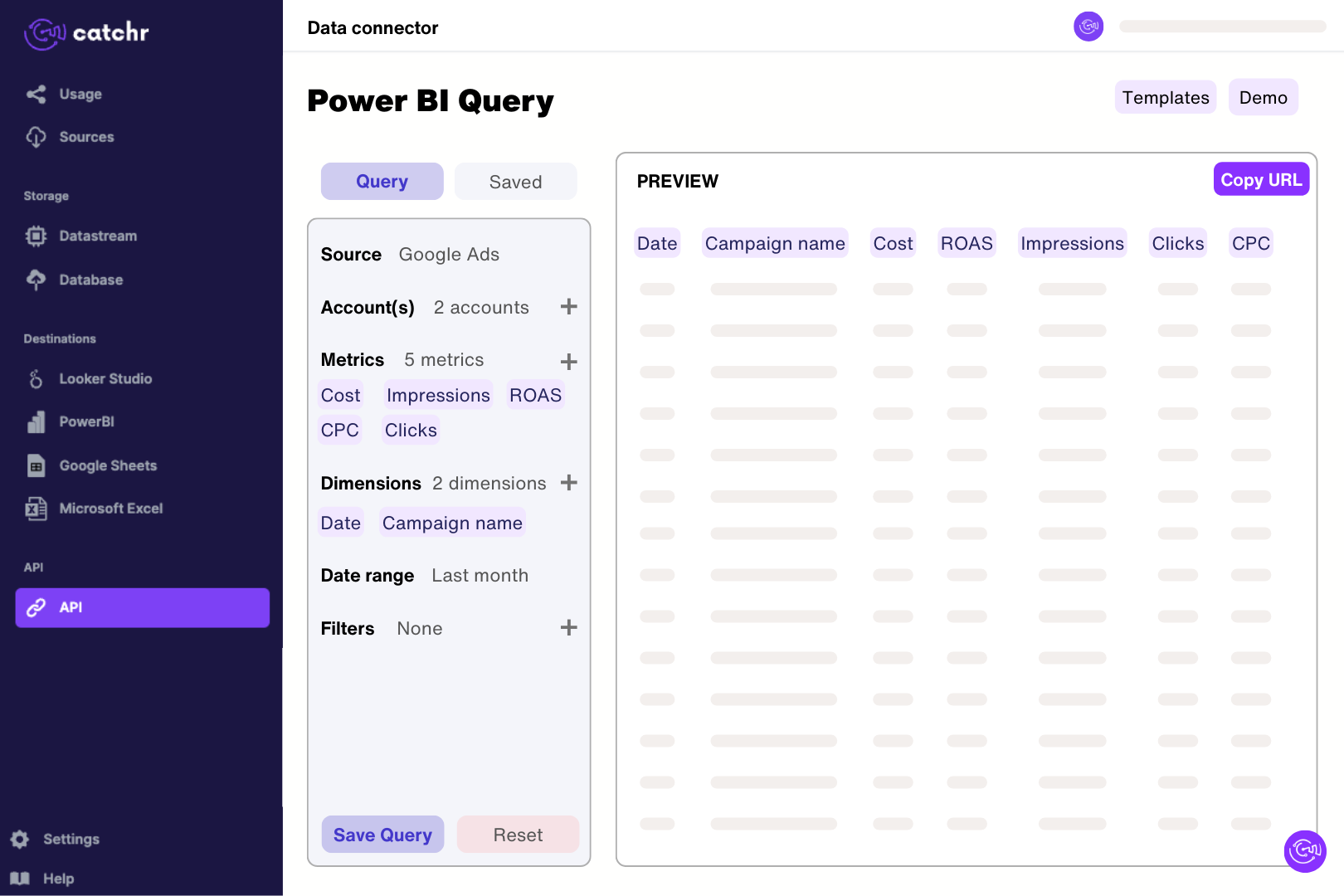
Add the review source in Catchr using the listing ID after /rooms/. Select the configured profile, app or property. Build a Power BI query with Review Date, Rating and Review Text, preview the returned reviews and import the generated URL using Get data > Web in Power BI Desktop. Set review dates and rating types in Power Query, and retain the source identifier when combining several profiles.
No. This source is for reviews associated with the selected Airbnb listings. Its fields include review text, date, rating, language, reviewer name, and a link to the review when available. It does not provide reservation revenue, occupancy, booking calendars, private guest feedback, or a guest's complete review history across Airbnb. Use booking or property-management data separately for financial and occupancy reporting.
The current Catchr catalog exposes a review Rating field, but no separate cleanliness, check-in, communication, location, accuracy, or value scores. Airbnb treats the overall rating as a separate guest assessment, not an average of those category scores. You can read Review Text to investigate recurring comments about cleaning or arrival, but a text-based category you create is not an official Airbnb subcategory rating. See Airbnb's rating definitions.
Use the average of valid Rating values for the reviews in your selected period, rather than summing ratings. Count distinct Review IDs to measure review volume and group by Review Date for a monthly trend. Catchr also exposes a listing-level Review Count, which is a current total rather than the number posted in the selected month. Keep that total in a separate chart: listing totals cannot be requested together with individual review fields.
A review cannot appear before Airbnb publishes it. For home stays, Airbnb publishes the reviews when both parties have submitted them or when the 14-day review window ends, whichever happens first. After publication, check the listing identifier, your dashboard's review-date range, and data freshness. The review date is not the checkout date, so a stay ending in one month can produce a review in the next. Catchr does not expose unpublished reviews.
Do not assume that one request is a complete archive. Catchr retrieves review pages and stops paging once roughly 1,000 matching reviews have been collected, or when the available results or requested dates end. A large listing can therefore return fewer individual reviews than its listing-level Review Count. Use narrower review-date periods and check the returned coverage before calculating long-term trends. Selecting older dates does not guarantee that all older reviews remain available.
Yes. Configure the listing identifiers you want to monitor and keep Account ID in the comparison so reviews stay attached to the right property. Compare average rating alongside the number of retrieved reviews and the same review-date period; a five-star average based on two reviews is different evidence from one based on hundreds. For a wider hospitality dashboard, add a separate Booking.com reviews data source and keep each platform's rating scale visible.
Our team is always here to answer any questions you may have about our data connector.
Connect your marketing platforms and build a data workflow your entire agency can use.





.svg)




























.png)




.svg)