Starter
For freelancers and small teams.
$ 24 /mo
Billed monthly · cancel anytime
Platforms3
Accounts10
.svg) Instagram Public Data query · Power BI format
Instagram Public Data query · Power BI format
 Instagram Public Data
One source
Instagram Public Data
One source
 Saved query
API URL
Power BI
Web · Import
Saved query
API URL
Power BI
Web · Import
Used by the world's leading companies








Available metrics
Available dimensions
Instagram Public Data
3 advertising accounts
Connected
 Google Ads
2 advertising accounts
Connected
Google Ads
2 advertising accounts
Connected
 Google Analytics 4
1 web property
Connected
Google Analytics 4
1 web property
Connected
 HubSpot
1 CRM portal
Connected
HubSpot
1 CRM portal
Connected

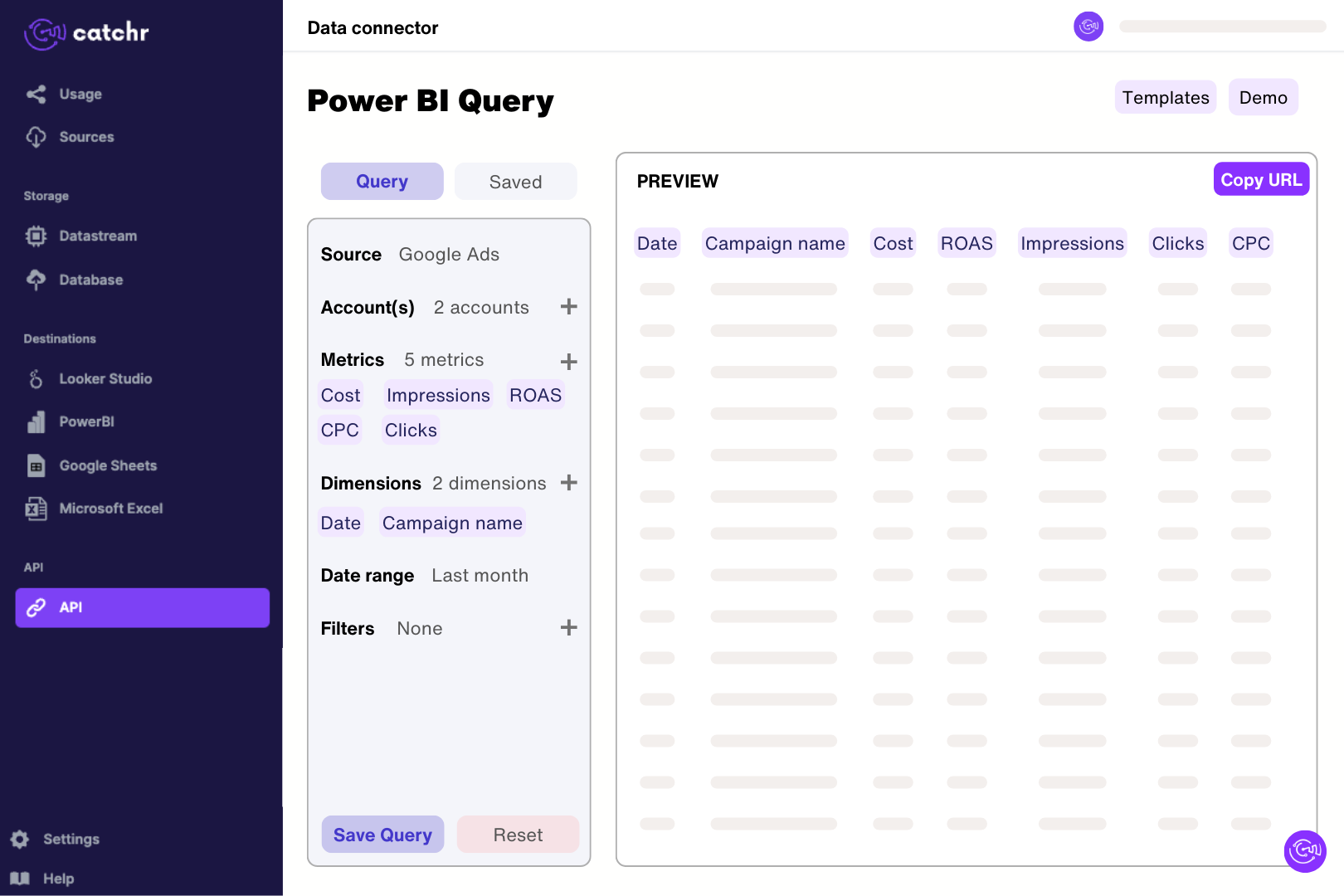
Authorize the Facebook connection with access to a Page linked to an Instagram Business or Creator account and enter the target usernames in Catchr. In Catchr’s Power BI query builder, select username, publication links and available public counters and preview a short extraction. Import the generated URL through Get data > Web in Power BI Desktop. Check the returned rows before building measures, keeping profile and publication identifiers, without treating current counters as historical daily values clear in the model.
Yes, for eligible Business or Creator accounts available through Meta's Business Discovery feature. You authorize your own qualifying account, then request supported public information about the target profiles. This is not access to every Instagram account: personal accounts and age-gated professional accounts are outside this feature's coverage. Private insights, messages, and restricted content are not unlocked by entering a username.
Catchr exposes profile metadata and current follower, following, and media counts. For returned publications, the catalog includes captions, media type, publication time, links, images or thumbnails, and like and comment counts. It also derives hashtag and caption-length fields from the caption. Reach, impressions, saves, shares, and audience demographics are not included in this public-data catalog. For your own account's private analytics, use the separate Instagram source.
The selected dates filter publications by their posting timestamp. Likes and comments are the current counts returned for those publications, not a daily record of when each interaction happened. A report for posts published last month can therefore change as those posts receive more engagement. Label it as performance of posts published in the selected period, rather than engagement generated exclusively within that period.
The follower count is a current profile snapshot. Changing the Catchr query's date range does not recover the number of followers the profile had on an earlier day. To measure growth over time, retain dated snapshots and calculate the change between them. Do not sum follower counts across publication rows: the same account total can be repeated without representing additional people.
Compare likes and comments per returned post alongside posting volume, media format, and the time each post has had to accumulate interactions. If you calculate engagement relative to followers, state the formula and that it uses the current follower count; it is not a reach-based engagement rate. Keep profiles and publication IDs distinct, and use the permalink to inspect outliers before declaring a content format or competitor more effective.
You can group returned publications using media type and the hashtags found in their captions, then compare available likes and comments. This is analysis of the configured profiles' publications, not a search of every Instagram post using a hashtag. The public-data catalog does not include Reel play counts, watch time, or retention. Avoid treating a video thumbnail or media-type label as evidence that those private performance metrics are available.
Our team is always here to answer any questions you may have about our data connector.
Connect your marketing platforms and build a data workflow your entire agency can use.





.svg)




























.png)




.svg)