Starter
For freelancers and small teams.
$ 24 /mo
Billed monthly · cancel anytime
Platforms3
Accounts10


Used by the world's leading companies










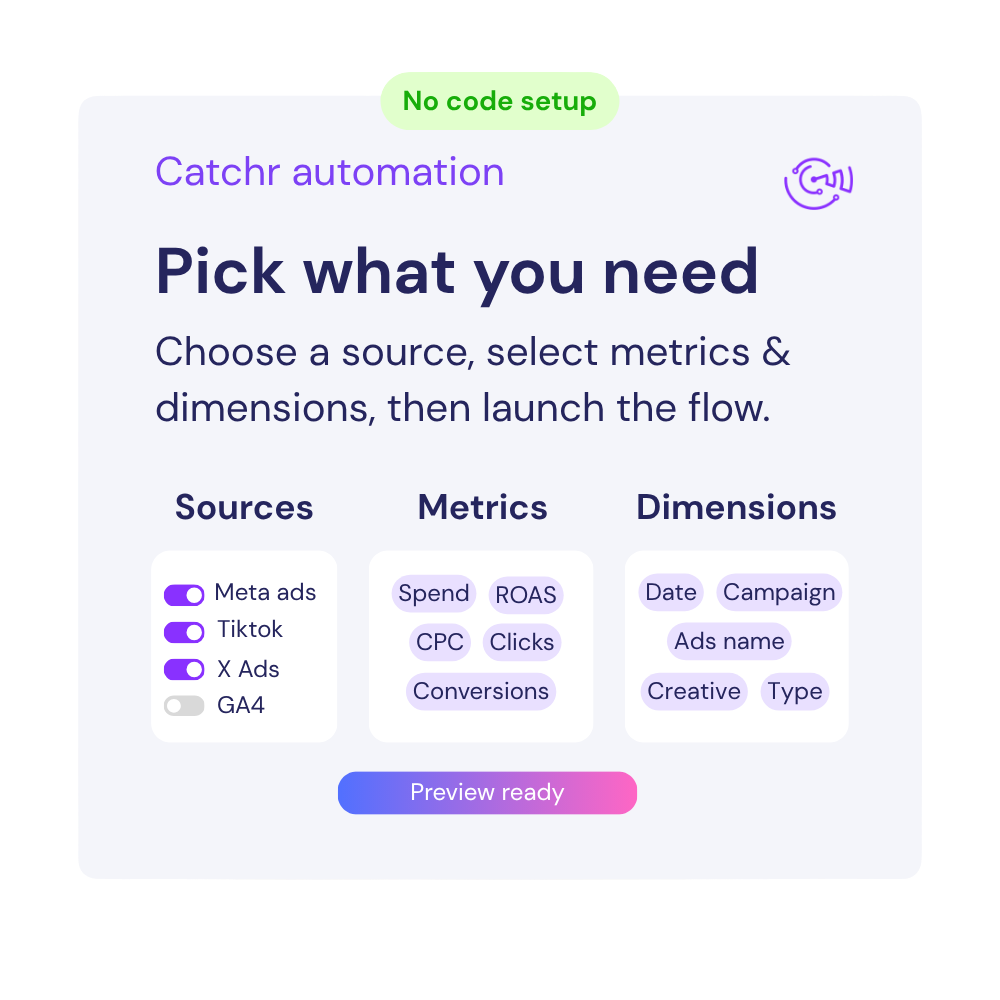


Available metrics
Available dimensions


What our customers say about us.
After three years of use, Catchr has become essential for both our teams and our clients. So far, it has been our best solution for compiling and analyzing data from different advertising platforms. It’s easy to set up, and the customer service is responsive and excellent.

With Catchr’s automated API, we can finally collect and centralize all advertising data, connect it with booking information, and calculate the real ROAS for our restaurant clients. It gives them full visibility, more autonomy, and the ability to optimize campaigns to maximize ROI.

The solution is a real game changer, providing optimal time savings for our data reporting. The major strength of the solution is their highly responsive and professional support.

Connect YouTube in Catchr using a Google account authorized to access the channel's analytics, then select the channel in your Catchr data source for Looker Studio. Begin with a channel-level report for a recent completed period using Views and Estimated Minutes Watched. Add video titles and other breakdowns once the totals match your intended channel and date range. Public access to a channel page does not grant access to its private analytics or revenue.
Yes. Google provides a native YouTube Analytics connector, so a third-party connector is not required for every YouTube dashboard. Catchr offers a separate connection alongside your other marketing sources. Compare the fields, channel access, and reporting workflow you need before choosing. Google's YouTube Analytics connector guide explains its connection options; those options should not be assumed to match Catchr's setup exactly.
Catchr's catalog includes views, estimated watch time, average view duration, likes, comments, shares, subscribers gained and lost, and monetization metrics where permitted. Channel and video reporting can use supported breakdowns such as country, traffic source, device, and viewer demographics. YouTube restricts which metrics and dimensions work together, so build focused charts rather than combining every breakdown in one table. Small audience segments may also be unavailable rather than representing zero viewers.
Use Estimated Minutes Watched for viewing time over the selected period and divide by 60 if you want hours. Keep that total separate from Average View Duration, and do not add averages across days or videos. Calculate net subscriber change as Subscribers Gained minus Subscribers Lost for the same scope and dates. The channel's current Subscriber Count is a separate snapshot; repeating it on dated rows does not create historical subscriber totals.
First match the channel, video selection, date range, filters, and metric definition. A current Video View Count or channel total is not the same as Views measured during a selected period. YouTube Analytics also returns data only through the last day for which all requested metrics are available, so adding a slower metric can shorten the returned period. Check recent days separately and start with a simple views report before adding revenue or detailed audience breakdowns.
Catchr exposes Creator Content Type for supported analytics combinations, which can help separate content formats. Keep the view definition in mind: YouTube changed Shorts Views on March 31, 2025 to count starts and replays without a minimum watch time. A trend spanning that change needs context. Catchr's current field catalog does not expose Engaged Views, so do not relabel Views as that metric or assume it measures the same viewing behavior across formats.
Catchr includes estimated revenue, estimated ad revenue, monetized playbacks, ad impressions, and CPM-related fields for channels with the required access and available monetization data. Estimated revenue is not a finalized payout, and ad impressions are not the same as video views. These measures concern monetization of your channel. For money you spend promoting videos, use the Google Ads source and keep advertiser spend separate from creator earnings.
Yes. Connect the channels you are authorized to report on and retain channel and video IDs when comparing results. Use consistent dates and metric definitions, and avoid duplicating channel totals across video rows in a blend. Add website or campaign data separately to explore how content supports acquisition. For example, compare YouTube trends with GA4 reporting, while treating correlations as context rather than proof that a particular viewer became a customer.
Our team is always here to answer any questions you may have about our data connector.