

AI search is changing how people discover software. Instead of scanning links, users now ask direct questions and expect immediate answers. That shift is exactly why GEO matters for marketing teams.
GEO Basics: From search rankings to AI Answers
What is GEO?
GEO (Generative Engine Optimization) is the practice of writing and structuring content so AI-powered search systems can understand it, trust it, and reuse it in generated answers. Unlike classic search results, AI interfaces often synthesize information from multiple sources and present one direct response. GEO helps your content become one of those source candidates.
GEO and SEO
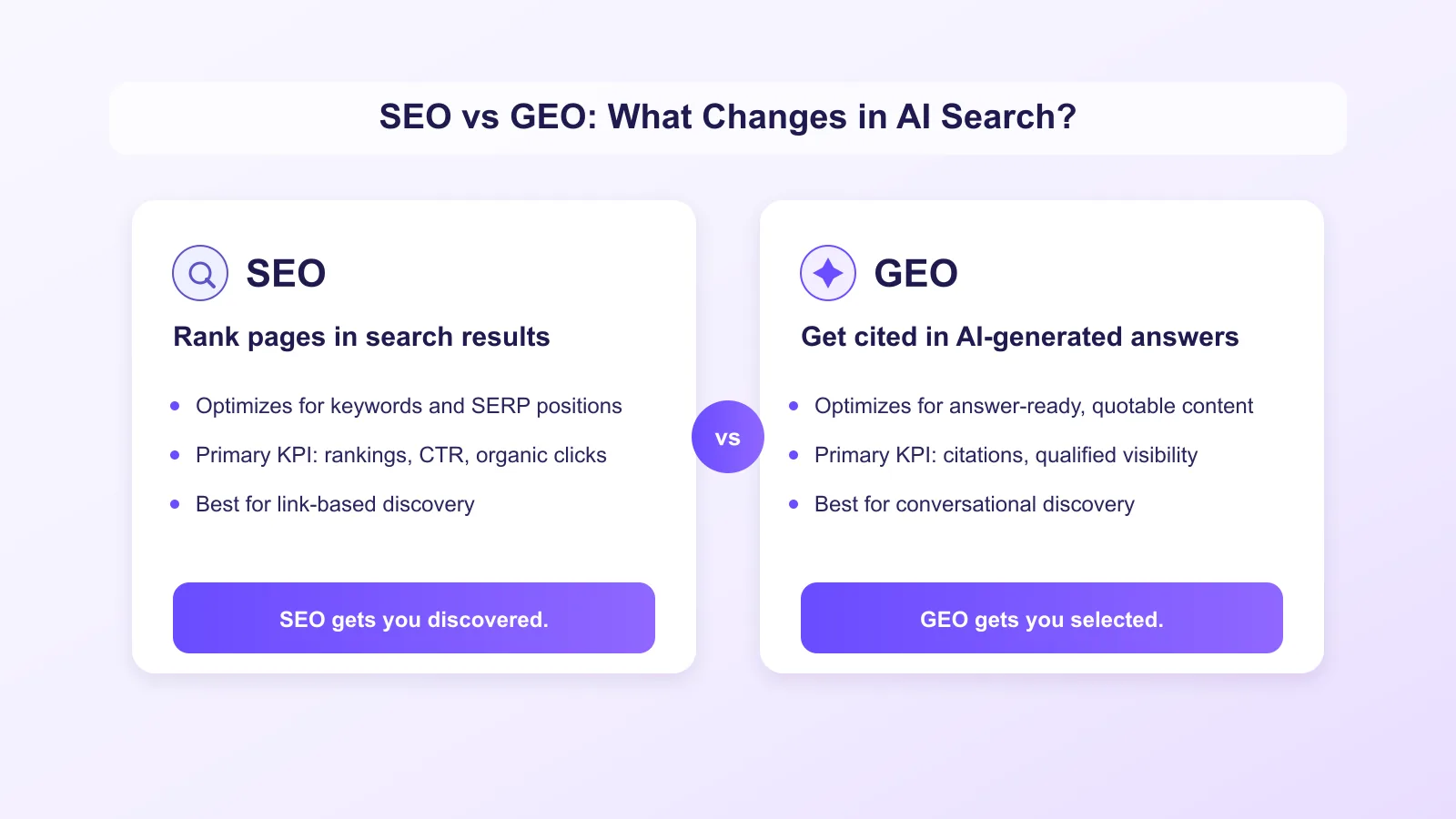
GEO does not replace SEO. Strong technical foundations still matter: crawlability, indexability, page speed, internal linking, and clear page intent. GEO adds another layer: your content must be answer-ready, easy to quote, and supported by credible evidence.
A simple way to think about it is this: SEO helps pages get discovered; GEO helps answers get selected.
Why GEO matters now
Users increasingly use AI interfaces to ask direct, practical questions and expect immediate, specific answers. Recent evidence supports this behavior change: Gartner reported in 2025 that 51% of consumers had changed research habits due to GenAI, and Google said early AI search users submitted queries 2–3x longer than traditional searches.
This shift favors content that defines terms quickly, explains concepts with clear steps, and uses precise language over vague claims. When a page is hard to parse or lacks structure, it is less likely to be selected as a source.
As AI-led discovery grows, marketing teams need to adapt both how they work and how they structure the content they publish.
How to Build GEO-Ready Content
Start with real questions
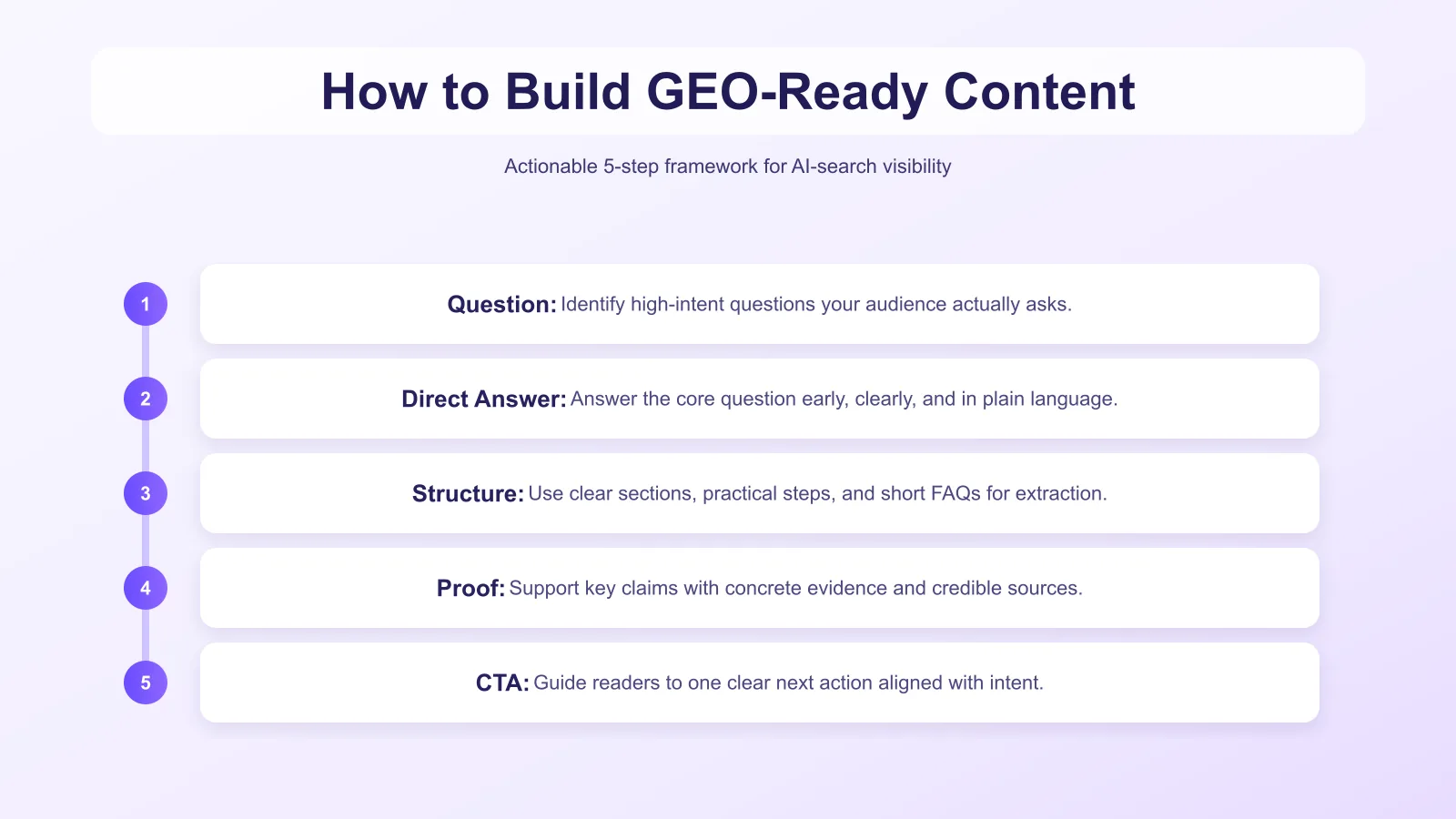
Start with the exact questions your audience asks, not just keyword variants. In GEO, long, contextual prompts matter because AI systems retrieve and synthesize answer-ready content. Put the direct answer near the top of the section in plain language.
Structure for citation
Use one clear H1, focused H2 blocks, and explicit H3 questions. GEO rewards modular, self-contained answers that can be quoted cleanly. Keep paragraphs short, add definition blocks, steps, and a short FAQ.
Support claims with proof
In GEO, credibility strongly affects citation likelihood. Replace vague claims with specific facts, practical examples, and credible sources. Keep product proof concrete and verifiable.
Connect visibility to conversion
SEO and GEO should both drive business outcomes, not just visibility. The real difference is the user’s entry point: with SEO, users often arrive from ranked results; with GEO, they often arrive after seeing your brand or content in an AI-generated answer. In both cases, the page should move users from discovery to action through relevant internal links and one clear, intent-aligned CTA.
How Catchr’s Brand Hub GEO Feature Helps
Turn GEO into a measurable, repeatable system
The GEO feature in Catchr’s Brand Hub helps teams move from assumptions to measurable visibility. It tracks brand presence in GenAI responses and provides visibility scores, so you can quickly see where your brand is strong, weak, or missing.
It also enables an automated workflow to monitor score evolution over time, based on prompts defined and prioritized by the user. This makes GEO actionable: define prompts, track score trends, identify gaps, and adjust content strategy with clear performance signals.
Frequently Asked Questions
Does GEO replace SEO?
No. GEO extends SEO. You still need technical SEO and strong on-page fundamentals.
Do I need special technical markup for GEO?
Not as a universal requirement. The foundation remains clear, useful, crawlable content that demonstrates expertise and trust.
What should I publish first?
Start with one high-intent definition page in your category, answer the core question immediately, include proof, and add a clear CTA tied to a money page.
Is SEO compatible with GEO, or should I publish separate articles?
SEO and GEO are compatible. In most cases, one well-structured page can serve both goals: rank in search and be cited in AI answers. You usually do not need two separate articles.
Can I adapt an existing SEO article for GEO?
Yes. Start by adding explicit question-led H2/H3 sections, move direct answers higher in the page, tighten paragraphs, and add stronger evidence and source citations.
How do I know if my GEO content is improving?
You can measure AI brand visibility by tracking visibility scores by prompt, monitoring score trends over time, and connecting those trends to page engagement and conversions. You can do this with Catchr, which connects your marketing platforms to reporting tools, spreadsheets, and databases. Catchr also includes GEO monitoring, so you can measure your brand’s visibility across AI-generated answers.
> Try Catchr for free (14-days trial)
Final Takeaway
If your buyers are using AI to evaluate tools, your content must be easy to cite, not only easy to rank. GEO is the operating layer that helps you earn that visibility. With Catchr’s Brand Hub GEO feature, teams can scale this approach with consistent messaging and clearer paths to trial, demo, and subscription.

.png)