
Agency promptCopy prompt
Replace [variables] Facts ≠ hypotheses Action + follow-up metric


Trusted by marketing teams that talk to data every day








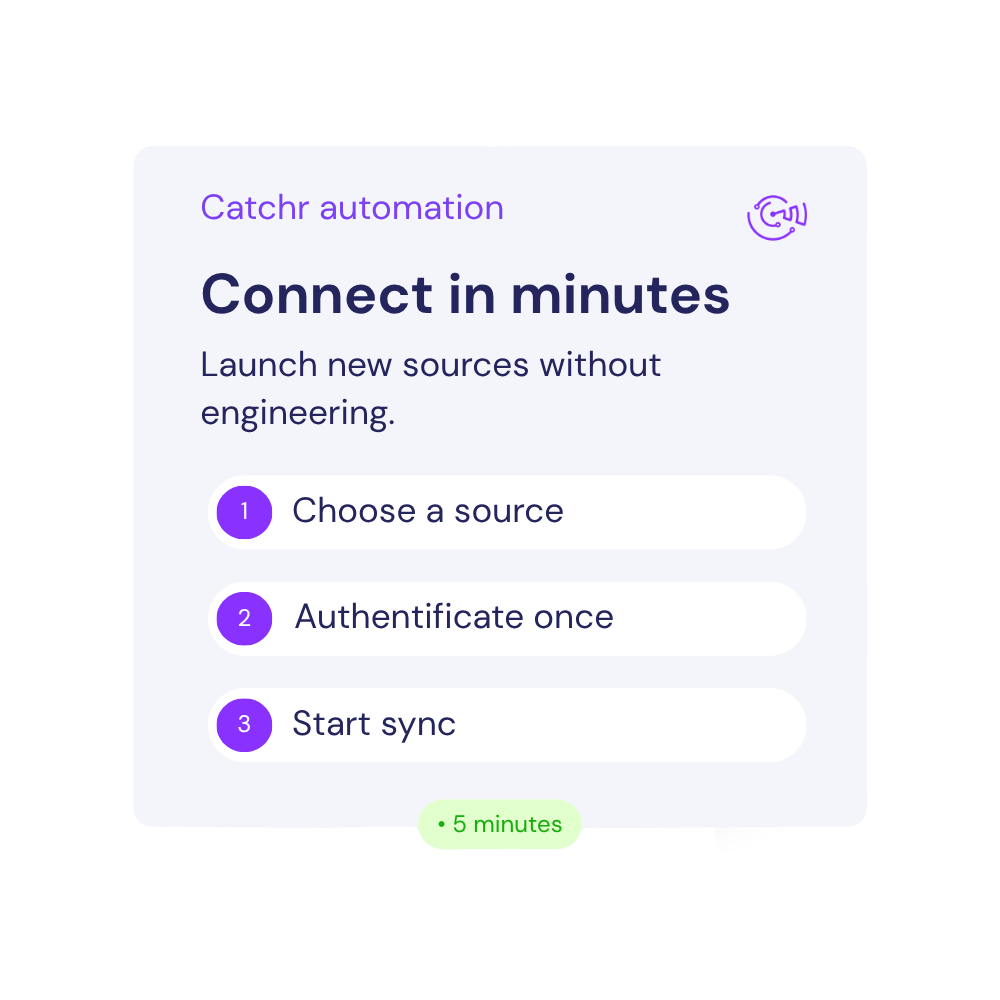
Three steps, from Catchr to your first answer. No code, and nothing to install on your machine.
 Meta Ads
3 advertising accounts
Connected
Meta Ads
3 advertising accounts
Connected
 Google Ads
2 advertising accounts
Connected
Google Ads
2 advertising accounts
Connected
 Google Analytics 4
1 web property
Connected
Google Analytics 4
1 web property
Connected
 HubSpot
1 CRM portal
Connected
HubSpot
1 CRM portal
Connected

Open the Catchr MCP entry in the Claude connector directory, add it, then sign in to Catchr and review the access Claude asks for.
Replace account, period, KPI target, and threshold variables before you ask Claude.

Which one fits depends on what you need Claude to do, and on how many sources the question touches.
Compare your options
Sources
Sources
Sources
The data in your file
Connection
Connection
One Catchr workspace
Connection
Upload a CSV or Excel file
Next question
Next question
Query connected sources
Next question
Export again if the scope changes
Catchr gives Claude eight tools, and all eight of them read.
Claude can list the platforms and accounts connected to your workspace, browse the available fields, and run reporting queries against them. That covers spend, delivery, conversions, and creative performance, down to the level you ask for.
Claude cannot create, pause, or edit a campaign, move a budget, publish an ad, or change an audience. There is no write permission to grant, so there is none to supervise.
In Ads Manager. Decide in the conversation what to change and why, then act with the access and the review your team already uses.
Choose your role, open a workflow, then replace the bracketed variables before pasting the prompt into Claude. Every prompt asks for evidence, limits, and a concrete output.
“Why did CPA rise?” sounds simple. The answer is usually buried across exports, formulas, filters, and tabs before the analysis can even start.
Choose the right account, date range, breakdowns, and fields. Then wait for the file and do it again when the question changes.
Rename columns, fix formats, join tabs, and check formulas before you can trust the comparison.
Turn the numbers into a client-ready answer, then repeat the whole process for the inevitable follow-up.
Catchr MCP gives Claude access to the marketing accounts you select, so each follow-up starts with the same marketing context instead of a new manual export.
Clear answers for marketers comparing connectors, data sources, reporting workflows, and dashboard setup.
Claude can analyze the PostHog event records returned through Catchr. Available fields include a Records counter for each exported event, UTM Campaign, and time dimensions such as date, hour, week, month, quarter, and year, making it useful for campaign and event-volume reporting.
Claude can group returned PostHog events by UTM Campaign and available time dimensions, from hour and date to week, month, quarter, or year. Ask it to state the selected period, filters, and grouping before comparing event counts.
Yes. Claude can use the Records counter and available date dimensions to compare returned event volumes across days, weeks, months, quarters, or years. Specify the periods, campaign filter, and comparison you need in your prompt.
Claude can identify spikes, drops, and other patterns in the returned PostHog events by comparing Records across UTM Campaign and time dimensions. It should present these as observations, not confirmed causes, and suggest what to validate next.
Use prompts with a clear period, campaign scope, grouping, and desired output. For example, ask Claude to compare weekly event counts by UTM Campaign, highlight unusual daily changes, summarize monthly activity, or prepare a concise campaign event report.
Yes, when the other sources are also connected through Catchr. Ask Claude to align dates, identifiers, and definitions before combining results; when a reliable join is not supported, request a side-by-side comparison instead.
Yes, provided each PostHog instance is connected and available through Catchr. The connector uses an explicit base URL to support US, EU, and self-hosted deployments, so Claude can compare their returned data while keeping each instance clearly identified.
You need a PostHog API key, the explicit base URL for your US, EU, or self-hosted instance, a Catchr workspace with PostHog connected, and Catchr MCP enabled in Claude. Available records depend on the connected instance and its permissions.
Claude analyzes the PostHog records returned through Catchr and should not assume they are real time. Freshness and historical coverage depend on the requested period, available data, permissions, and PostHog API behavior, so ask Claude to state the latest returned date and flag missing intervals.
No. Catchr MCP provides PostHog data to Claude for analysis and does not give Claude permission to edit events, change settings, or modify the PostHog instance. Use its findings to plan actions, then make reviewed changes in PostHog with the appropriate access.
Our team is always here to answer any questions you may have about our data connector.
Connect your marketing platforms to Claude with Catchr MCP and start investigating current campaign performance.