
Prepare data before every question.
- Export files from the marketing platform
- Reformat and reconcile columns
- Rebuild the analysis for each follow-up









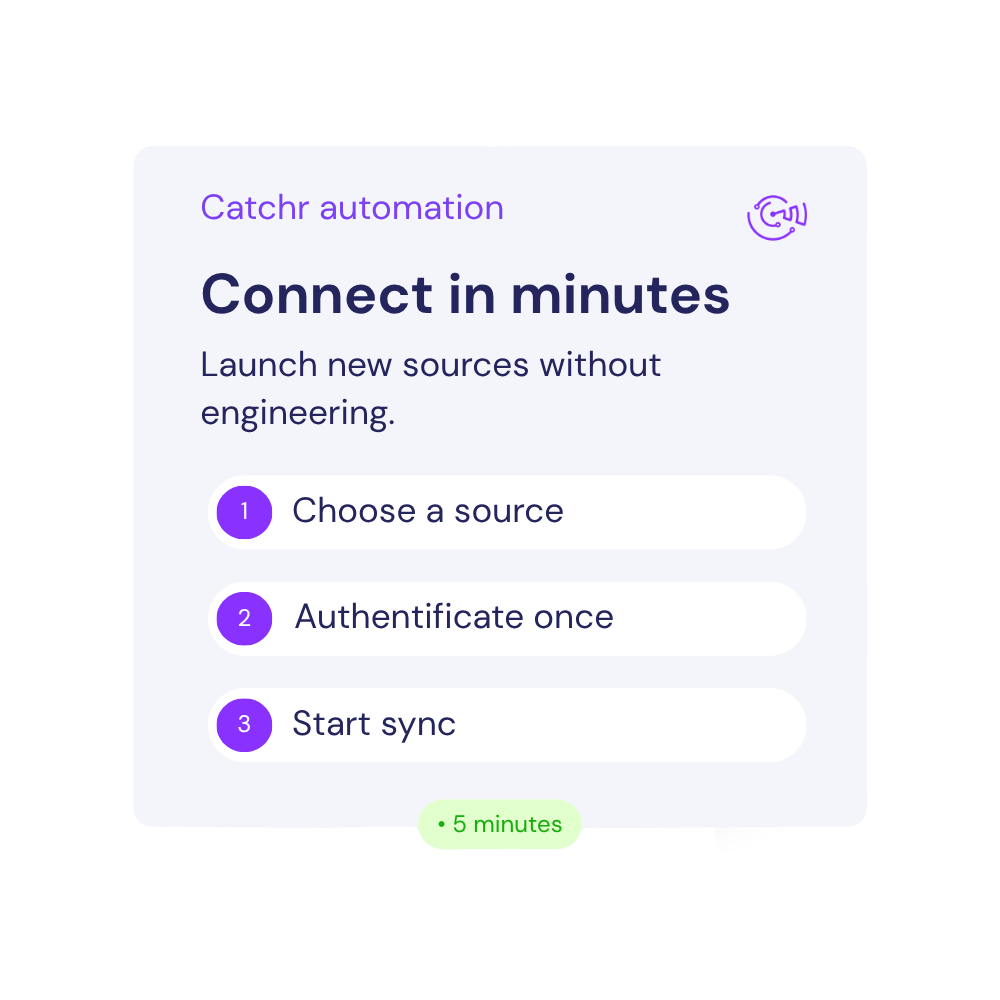
Three steps to your first source-aware prompt.
 Meta Ads
3 advertising accounts
Connected
Meta Ads
3 advertising accounts
Connected
 Google Ads
2 advertising accounts
Connected
Google Ads
2 advertising accounts
Connected
 Google Analytics 4
1 web property
Connected
Google Analytics 4
1 web property
Connected
 HubSpot
1 CRM portal
Connected
HubSpot
1 CRM portal
Connected

Configure the Catchr remote MCP connection in Claude using the connector details from Catchr.
Replace account, period, KPI target, and threshold variables before you ask Claude.

“Why did CPA rise?” sounds simple. The answer is usually buried across exports, formulas, filters, and tabs before the analysis can even start.
Choose the right account, date range, breakdowns, and fields. Then wait for the file and do it again when the question changes.
Rename columns, fix formats, join tabs, and check formulas before you can trust the comparison.
Turn the numbers into a client-ready answer, then repeat the whole process for the inevitable follow-up.
Catchr MCP gives Claude access to the marketing accounts you select, so each follow-up starts with the same marketing context instead of a new manual export.
Choose your role, open a workflow, then replace the bracketed variables before pasting the prompt into Claude. Every prompt asks for evidence, limits, and a concrete output.
Clear answers for marketers comparing connectors, data sources, reporting workflows, and dashboard setup.
Claude can query connected Klaviyo data for campaign, automation, deliverability, engagement, and audience health. Representative available fields include Emails Open Rate, Emails Clicked Rate, Shopify - Placed Order Value, Submitted Form, and Subscribed to List. Useful breakdowns include Campaign Name, Campaign Channel, Flow Name, List Name, and Date.
Claude analyzes the Klaviyo records returned through the selected Catchr connection. Exact availability can vary by selected account, report type, permissions, and requested period, so Claude should state which returned fields support its answer.
The available detail depends on the selected Klaviyo dataset and the reporting grain of its fields. Useful breakdowns include Campaign Name, Campaign Channel, Flow Name, List Name, and Date.
Ask Claude to state the grain, date range, timezone, filters, and any incompatible report types before it calculates totals, rates, or comparisons. Keep separate datasets apart unless their keys and definitions support a reliable join.
Yes, when the required fields are returned for the selected Klaviyo account. Claude can use Emails Open Rate, Emails Clicked Rate, Shopify - Placed Order Value, Submitted Form, and Subscribed to List together with Campaign Name, Campaign Channel, Flow Name, List Name, and Date to compare periods, entities, and targets.
Provide the account, period, comparison, business target, and minimum volume in the prompt. Claude should show the evidence behind each finding and identify any missing field before recommending action.
Claude can flag patterns and exceptions supported by the available Klaviyo records. It can compare Emails Open Rate, Emails Clicked Rate, Shopify - Placed Order Value, Submitted Form, and Subscribed to List across Campaign Name, Campaign Channel, Flow Name, List Name, and Date and rank the issues that deserve review.
An unusual value is not proof of a cause or operational error. Ask Claude to separate observations, possible explanations, and the next validation step so the result remains useful and defensible.
Strong prompts specify the account, date range, comparison, threshold, available fields, and required output.
Yes, when the other sources are also connected through Catchr. Useful combinations for this category include CRM, ecommerce, analytics, and advertising sources.
Align account scope, dates, currencies, attribution rules, identifiers, and business definitions first. If the sources cannot be joined reliably, ask Claude for a side-by-side comparison rather than a single attributed result.
Yes, provided each account or entity is connected and available through Catchr. Ask for separate results first, then request a combined summary.
Give Claude the account list, period, target, timezone, reporting grain, and materiality threshold. This prevents one large account or a definition mismatch from distorting the comparison.
You need access that can authorize the relevant Klaviyo data, a Catchr workspace with the source connected, and Catchr MCP enabled in Claude.
After selecting the required accounts or entities, you can ask questions in natural language without preparing a new CSV export for every analysis. Available fields still depend on the source connection and permissions.
Claude analyzes the records returned through the connected Catchr source and should not treat them as automatically real time. Freshness and historical coverage can vary by dataset, field, selected period, account, and source API limits.
Ask Claude to state the latest available record date, extraction date when present, timezone, requested period, and any missing intervals before interpreting a trend.
No. Catchr MCP provides Klaviyo data to Claude for analysis; it does not give Claude permission to edit source records, change settings, move money, publish content, or modify campaigns.
Use the result to prepare an action plan, then make operational changes in Klaviyo with the appropriate access and review. Prefer aggregated outputs whenever record-level details are not required.
Our team is always here to answer any questions you may have about our data connector.
Connect your marketing platform to Claude with Catchr MCP and start investigating current campaign performance.