
Prepare data before every question.
- Export files from the marketing platform
- Reformat and reconcile columns
- Rebuild the analysis for each follow-up


Trusted by marketing teams that talk to data every day








 Meta Ads
3 advertising accounts
Connected
Meta Ads
3 advertising accounts
Connected
 Google Ads
2 advertising accounts
Connected
Google Ads
2 advertising accounts
Connected
 Google Analytics 4
1 web property
Connected
Google Analytics 4
1 web property
Connected
 HubSpot
1 CRM portal
Connected
HubSpot
1 CRM portal
Connected

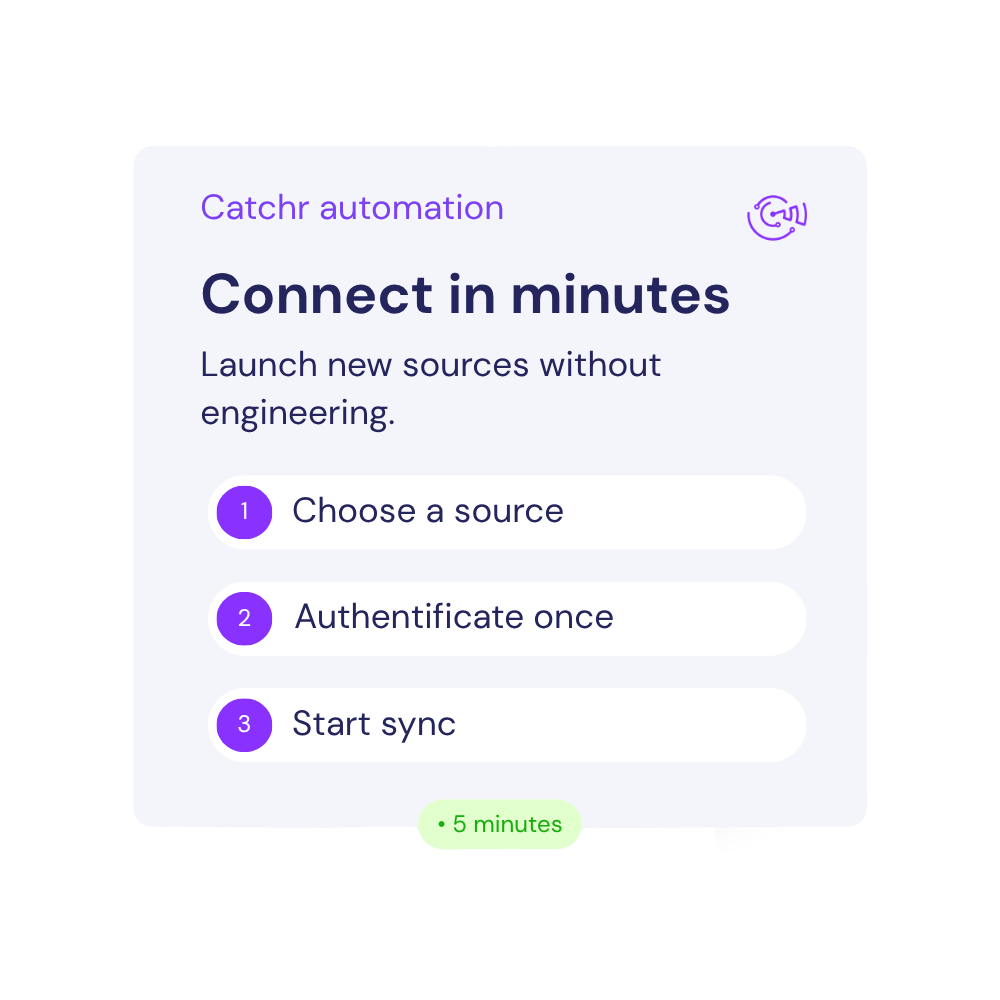
Configure the Catchr remote MCP connection in ChatGPT using the connector details from Catchr.
Replace account, period, KPI target, and threshold variables before you ask ChatGPT.

“Why did CPA rise?” sounds simple. The answer is usually buried across exports, formulas, filters, and tabs before the analysis can even start.
Choose the right account, date range, breakdowns, and fields. Then wait for the file and do it again when the question changes.
Rename columns, fix formats, join tabs, and check formulas before you can trust the comparison.
Turn the numbers into a client-ready answer, then repeat the whole process for the inevitable follow-up.
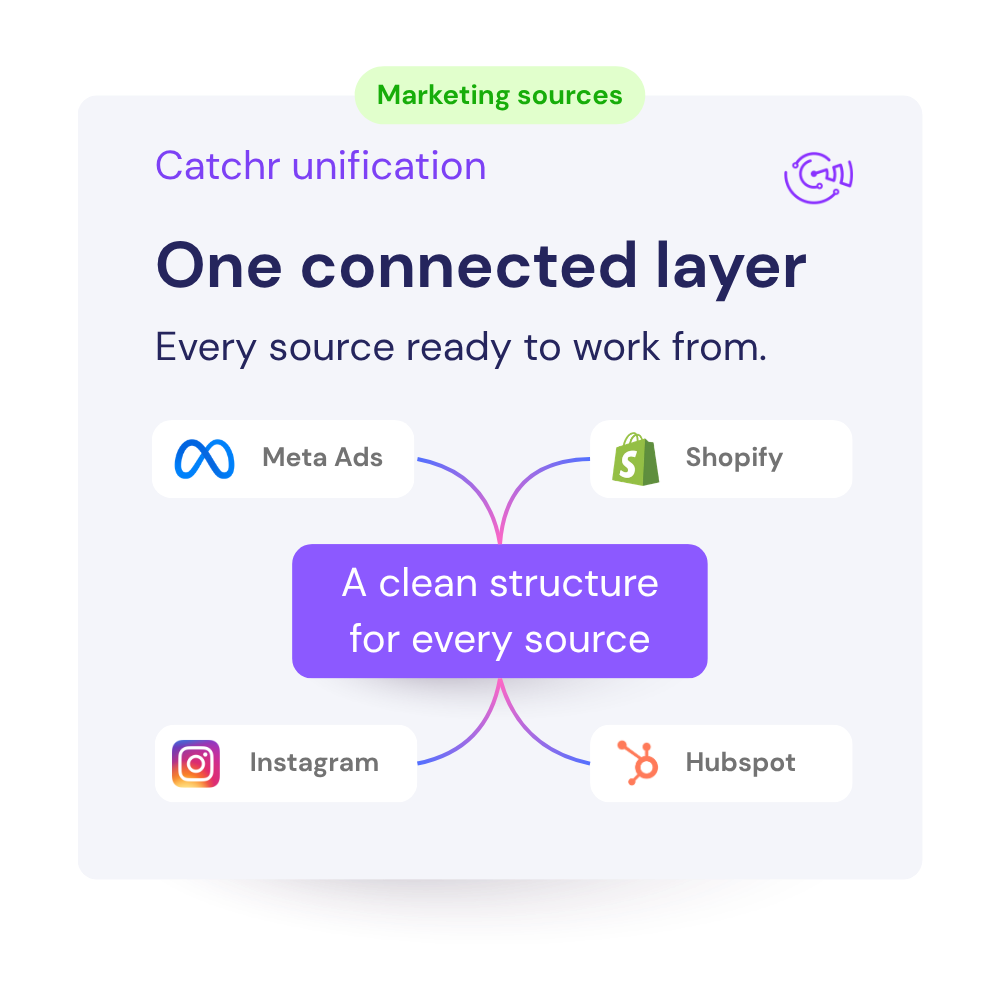
Catchr MCP gives ChatGPT access to the marketing accounts you select, so each follow-up starts with the same marketing context instead of a new manual export.
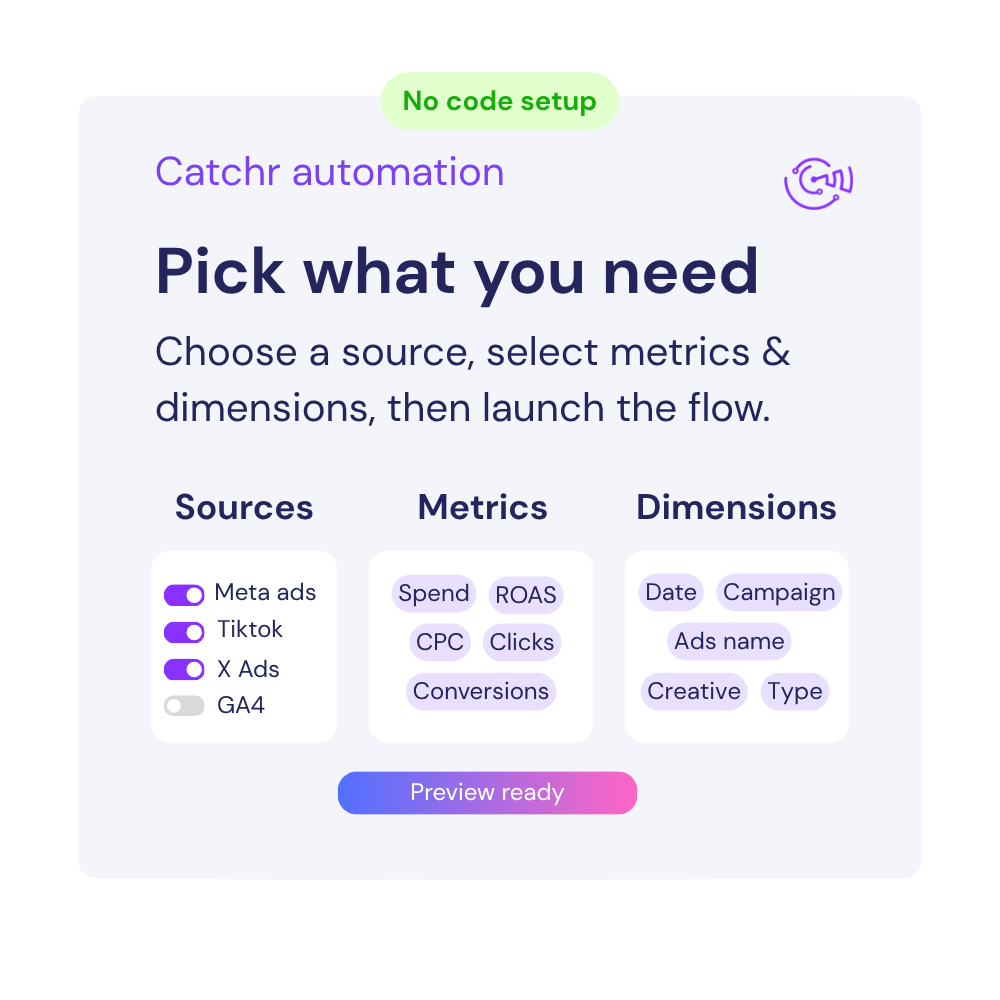
Choose your role, open a workflow, then replace the bracketed variables before pasting the prompt into ChatGPT. Every prompt asks for evidence, limits, and a concrete output.
Using the Catchr MCP, pull HubSpot deal data for [List of Client Account Names/IDs] over [Reporting Period] and assess each client's active pipeline against [Pipeline and Revenue Targets]. Use Deal Pipeline, Deal Stage, Deal Amount, Deal Forecast amount, Deal probability, Deal Close Date, Deal owner, Deal Last Activity Date, and Deal Next Activity Date. Summarize open pipeline value, forecast value, stage mix, overdue close dates, and deals without a scheduled next activity for every client; label each account Healthy, Watch, or Critical, then rank the accounts requiring attention and give one evidence-based action for each flagged client.
ChatGPT can query the HubSpot data available through your connected Catchr source, including supported contact, company, deal, pipeline, owner, lifecycle, source, activity, form, and marketing-email fields.
This supports pipeline reviews, funnel analysis, CRM hygiene checks, revenue forecasting, and client reporting. The exact scope depends on the HubSpot objects, properties, and associations returned for the selected account.
Yes, when the required fields are available. You can review contacts, lifecycle stages, original and latest sources, forms, email engagement, deals, pipelines, owners, activities, and closed-won revenue.
Associations matter: a contact source should not automatically be credited with deal revenue when the contact-to-deal relationship or source field is missing.
Yes. ChatGPT can use deal stage, amount, forecast amount, probability, close date, owner, last activity, next activity, and next step to identify overdue or underworked opportunities.
It can build committed, weighted, and best-case scenarios, but a forecast remains a planning view—not guaranteed revenue. Ask it to show the deals and assumptions behind every scenario.
Yes, if lifecycle stages, stage-entry dates, source fields, and required associations are populated. ChatGPT can compare contact volume, stage conversion, velocity, won deals, and revenue by source.
When timestamps or associations are missing, it should report the coverage gap instead of calculating an unreliable conversion rate or claiming causal attribution.
Specify the portal, pipeline or audience, period, comparison, and business target.
Yes, if the other sources are connected to Catchr. You can compare HubSpot leads, pipeline, and won revenue with advertising spend, web analytics, or Shopify sales to investigate the wider customer journey.
Use shared campaign or source identifiers when available. Without a reliable join, keep the analysis comparative and avoid presenting correlation as attribution.
Yes, provided each portal is connected and available to Catchr MCP. ChatGPT can review each portal or pipeline separately and then build a portfolio summary.
Define the pipeline, currency, lifecycle terminology, reporting period, and target for every account. Different stage definitions should be mapped or shown separately rather than silently combined.
You need access to the HubSpot account, a Catchr workspace with HubSpot connected, and Catchr MCP enabled in ChatGPT. Select the portal and objects required for the analysis.
Once connected, you can ask CRM and marketing questions in natural language without preparing a new export for every investigation.
ChatGPT analyzes the HubSpot records returned through the connected Catchr source. Freshness and historical coverage can vary by object, property, activity type, selected period, and source API availability.
For pipeline or campaign decisions, ask ChatGPT to state the latest record or activity date and highlight missing intervals, properties, or associations.
No. Catchr MCP provides HubSpot data for analysis; it does not give ChatGPT permission to edit contacts, advance deals, change owners, or update workflows.
Use ChatGPT to prepare a prioritized action or CRM-cleanup list, then review the evidence and make changes in HubSpot. Keep sensitive CRM details out of outputs that do not require record-level information.
Our team is always here to answer any questions you may have about our data connector.
Connect yout marketing platform to ChatGPT with Catchr MCP and start investigating current campaign performance.