
Prepare data before every question.
- Export files from the marketing platform
- Reformat and reconcile columns
- Rebuild the analysis for each follow-up


Trusted by marketing teams that talk to data every day








 Meta Ads
3 advertising accounts
Connected
Meta Ads
3 advertising accounts
Connected
 Google Ads
2 advertising accounts
Connected
Google Ads
2 advertising accounts
Connected
 Google Analytics 4
1 web property
Connected
Google Analytics 4
1 web property
Connected
 HubSpot
1 CRM portal
Connected
HubSpot
1 CRM portal
Connected

Configure the Catchr remote MCP connection in ChatGPT using the connector details from Catchr.
Replace account, period, KPI target, and threshold variables before you ask ChatGPT.

“Why did CPA rise?” sounds simple. The answer is usually buried across exports, formulas, filters, and tabs before the analysis can even start.

Choose the right account, date range, breakdowns, and fields. Then wait for the file and do it again when the question changes.
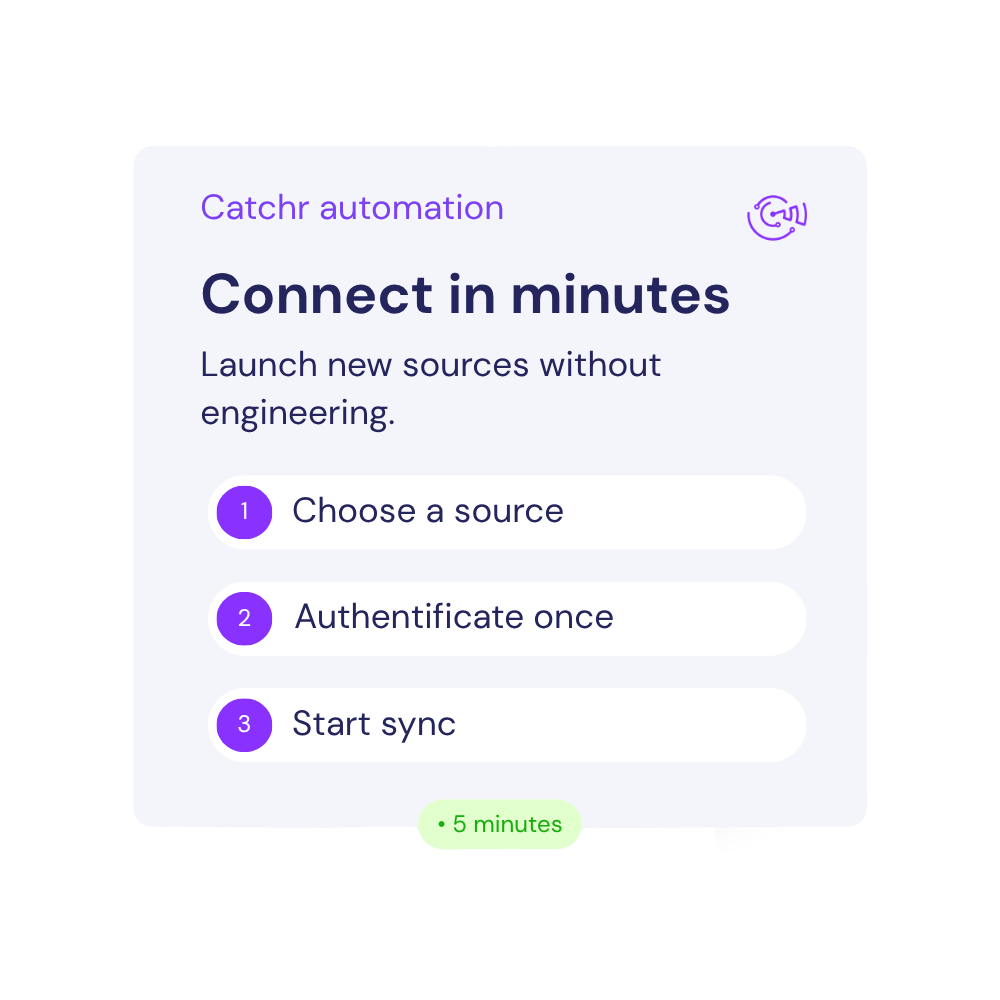
Rename columns, fix formats, join tabs, and check formulas before you can trust the comparison.
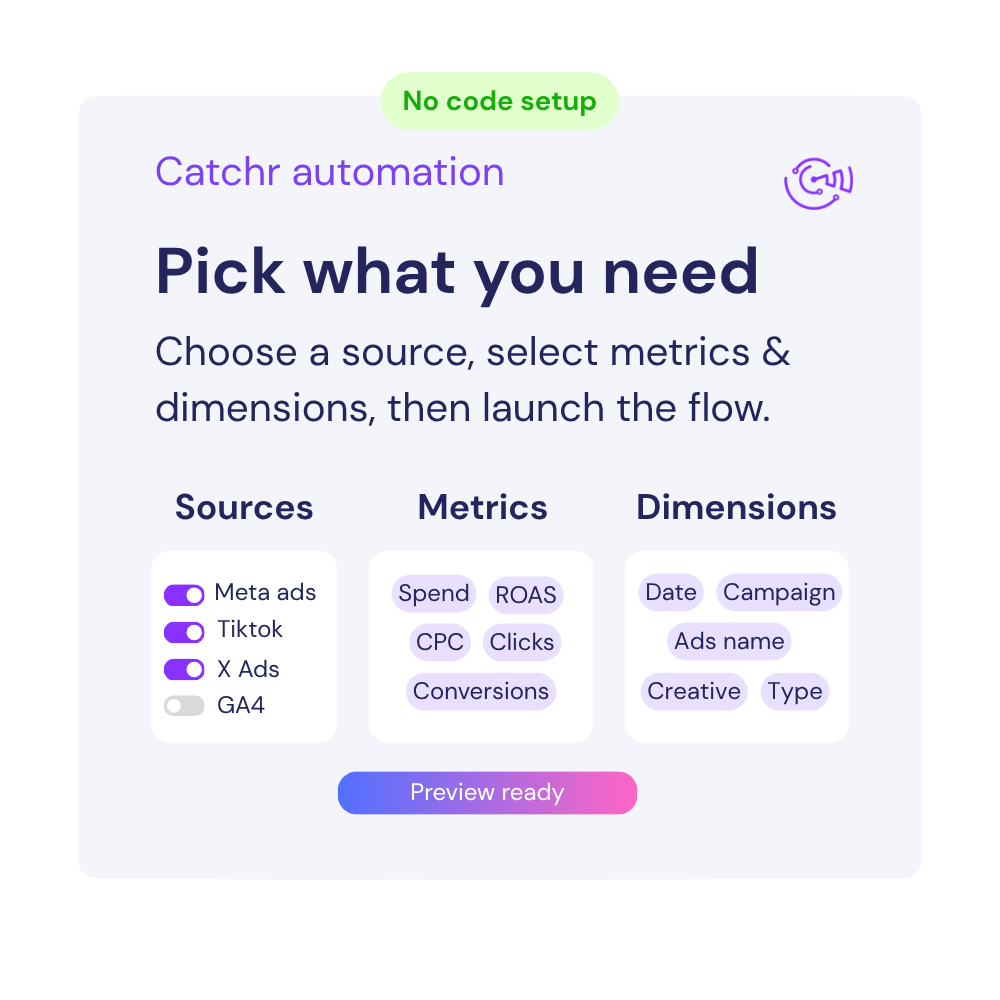
Turn the numbers into a client-ready answer, then repeat the whole process for the inevitable follow-up.
Catchr MCP gives ChatGPT access to the marketing accounts you select, so each follow-up starts with the same marketing context instead of a new manual export.
Choose your role, open a workflow, then replace the bracketed variables before pasting the prompt into ChatGPT. Every prompt asks for evidence, limits, and a concrete output.
Using the Catchr MCP, pull Amazon Ads performance for [List of Client Accounts] over [Period] and compare it with [Comparison Period]. For each account, summarize Cost, Sales, Purchases, Units Sold, Impressions, Clicks, Click Through Rate, and ROAS, using only field combinations supported by the relevant Amazon Ads report. Score each account against [Client ROAS Target], [Maximum Cost Growth], and [Minimum Sales Target], label it Healthy, Watch, or Critical, explain the data-backed reason for every Watch or Critical label, and return a ranked list of the accounts the consultant should review first today.
ChatGPT can query the Amazon Ads reporting data available in your connected Catchr account and turn it into campaign, product, keyword, search-term, and placement analysis.
The exact fields depend on the Amazon Ads report and its compatible reporting level.
You can ask for performance metrics such as cost, sales, purchases, units sold, impressions, clicks, CTR, CPC, ROAS, and supported attribution-window measures.
Break them down by campaign, ad group, advertised ASIN or SKU, keyword, search term, match type, targeting, placement, or date when those fields are available together. Catchr keeps incompatible Amazon report grains separate instead of forcing a misleading comparison.
Yes, when the selected Amazon Ads reports expose comparable fields. ChatGPT can compare campaigns or placements on measures such as cost, purchases, sales, ROAS, CTR, and CPC.
Ad-product-specific fields should remain in separate sections. For example, a Sponsored Brands new-to-brand metric should not be treated as though it were available for every campaign type.
Yes. You can investigate which ASINs generate efficient attributed sales, which keywords meet your ROAS or ACoS target, and which customer search terms may deserve an exact-match keyword or a negative-keyword review.
Include a date range, minimum click or purchase threshold, and target KPI so ChatGPT separates meaningful findings from low-volume noise.
Start with the decision you need to make, then add the account, period, comparison, and KPI target.
Yes, if the other sources are also connected to Catchr. You can compare Amazon Ads with Amazon Seller or Shopify to place attributed ad sales beside broader commerce results, or with Google Ads and Meta Ads for a channel-level view.
Use the same period and currency, and state the reporting level explicitly. Cross-source comparison is useful evidence, but it does not by itself prove attribution.
Yes, provided each account is connected and available to Catchr MCP. Ask ChatGPT to calculate results per account or marketplace first, then create the portfolio summary.
Specify marketplace, currency, timezone, targets, and reporting period. This prevents a large account or currency difference from distorting the comparison.
You need access to the Amazon Ads account you want to analyze, a Catchr workspace with that source connected, and Catchr MCP enabled in ChatGPT.
Once the relevant accounts are selected, you can ask questions in natural language. No CSV export or custom query code is required for the standard workflow.
ChatGPT analyzes the latest Amazon Ads records returned through the connected Catchr source; it should not assume the data is real time. Available history can vary by report, field, attribution window, and Amazon API coverage.
For time-sensitive work, ask ChatGPT to state the latest returned date, requested period, timezone, and any missing intervals before drawing conclusions.
No. Catchr MCP provides Amazon Ads data for analysis; it does not give ChatGPT permission to edit bids, budgets, targeting, or campaign status.
Use ChatGPT to investigate performance and prepare recommendations, then review the evidence and make operational changes in Amazon Ads.
Our team is always here to answer any questions you may have about our data connector.
Connect yout marketing platform to ChatGPT with Catchr MCP and start investigating current campaign performance.